
Case Study: Returning to Soccer in 6 Months Without ACL Surgery
Can an athlete return to high-level, cutting sports after a complete ACL tear—without surgery?
This case study breaks down how a 22-year-old collegiate soccer player successfully rehabilitated a complete ACL tear, Grade II MCL sprain, and lateral meniscal tear (O'Donoghue's "Unhappy Triad") non-operatively, returning to full competitive play in just 6 months.
The Injury & The Non-Operative Decision
Patient: 22-year-old female collegiate soccer midfielder.
Mechanism: Non-contact deceleration with valgus collapse and tibial rotation.
MRI Diagnosis: Complete mid-substance ACL tear, Grade II MCL sprain, and peripheral lateral meniscal tear.
The Clinical Choice: Landmark research (such as the KANON Trial and recent studies in BJSM & JOSPT) shows that non-operative rehab yields comparable long-term functional outcomes to surgery—and ACL tissue can even spontaneously heal under controlled loading. Guided by the Melbourne ACL Rehabilitation Guide 2.0, among other ACL rehab research, a structured 6-month non-operative trial was initiated.
The 6-Month Rehab Roadmap
Phase 1: Quiet the Joint & Restore Movement (Month 1)
Focus: Protect the healing MCL, eliminate joint swelling, and reactivate the quadriceps.
Key Interventions:
Hinged knee brace locked at 0-90 degrees for weeks 1–3.
Neuromuscular Electrical Stimulation (NMES) paired with quad sets and Straight Leg Raises (SLR).
Passive extension boards to restore 0 degrees extension.
1-Month Test Benchmarks: Zero quad lag, 0 degrees knee extension, flexion 120 degrees, minimal effusion (1+ on stroke test), and normal walking gait.
Phase 2: Heavy Resistance & Balance (Months 2–3)
Focus: Build quads and hamstrings (which act as ACL synergists) and prevent valgus collapse.
Key Interventions:
Heavy resistance (3 x 6–10 reps at 75–85% 1RM): Single-leg press, Romanian Deadlifts (RDLs), Bulgarian split squats, and Nordic hamstring curls.
Single-leg dynamic balance and perturbation training.
Phase 3: Running, Agility & Impact (Month 4)
Focus: Straight-line running, multi-directional deceleration, and landing mechanics.
Criteria to Start: Quad/Hamstring strength symmetry 80% (LSI) and zero swelling.
Key Interventions:
Graded walk/jog treadmill intervals progressing to continuous outdoor running.
Snap-downs, double-to-single leg box landings, and 45 degree cut-and-decelerate drills.
Phase 4 & 5: Sport-Specific Agility & Return-to-Play (Months 5–6)
Focus: Reactive cutting, soccer technical drills, contact readiness, and psychological confidence.
Key Interventions:
Visual cue agility, ball work while changing direction, and depth jumps.
Transition from non-contact team training to full scrimmages.
Return-to-Sport (RTP) Testing: Month 1 vs. Month 6 Clearance
To grant full clearance at Month 6, the athlete underwent a strict Melbourne ACL 2.0 Testing Battery:
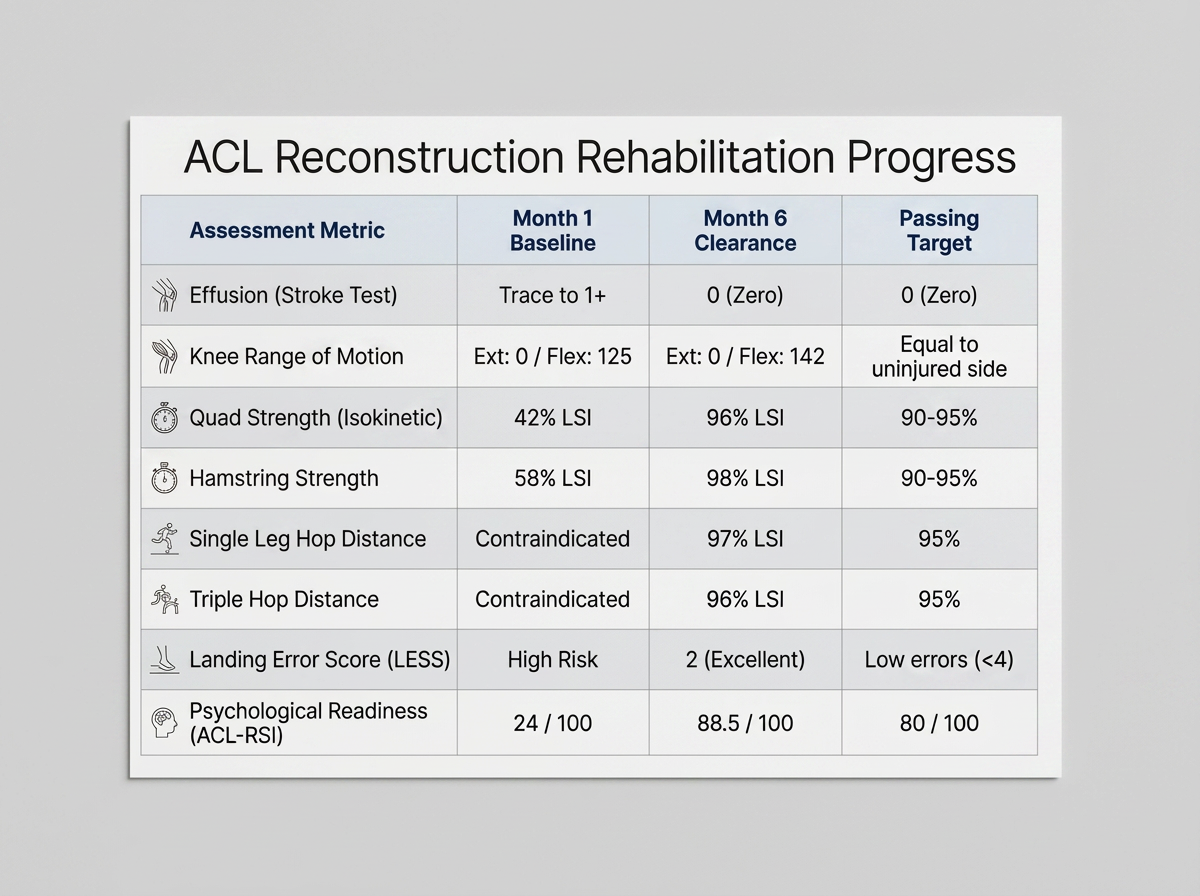
Sample testing number for RTP clearance
Key Takeaways
Dynamic Stability Wins: Progressive, high-load strength training (especially of the hamstrings and quads) creates the dynamic joint stiffness required to compensate for the missing ligament.
"Unhappy Triads" Can Heal Non-Operatively: Grade II MCL sprains and vascular peripheral meniscal tears possess excellent intrinsic healing potential when shear/valgus forces are controlled early. There is now research that presents potential for individuals to return to sport after a complete ACL tear without surgery! This is not necessarily for everyone, but the evidence is promising.
Criteria Over Time: Passing objective physical, strength, and psychological benchmarks (rather than just waiting 6 months) is the key to preventing re-injury upon return to sport.